AI-Assisted Excimer Laser Technology

The Gold Standard in Refractive Excimer Laser Technology

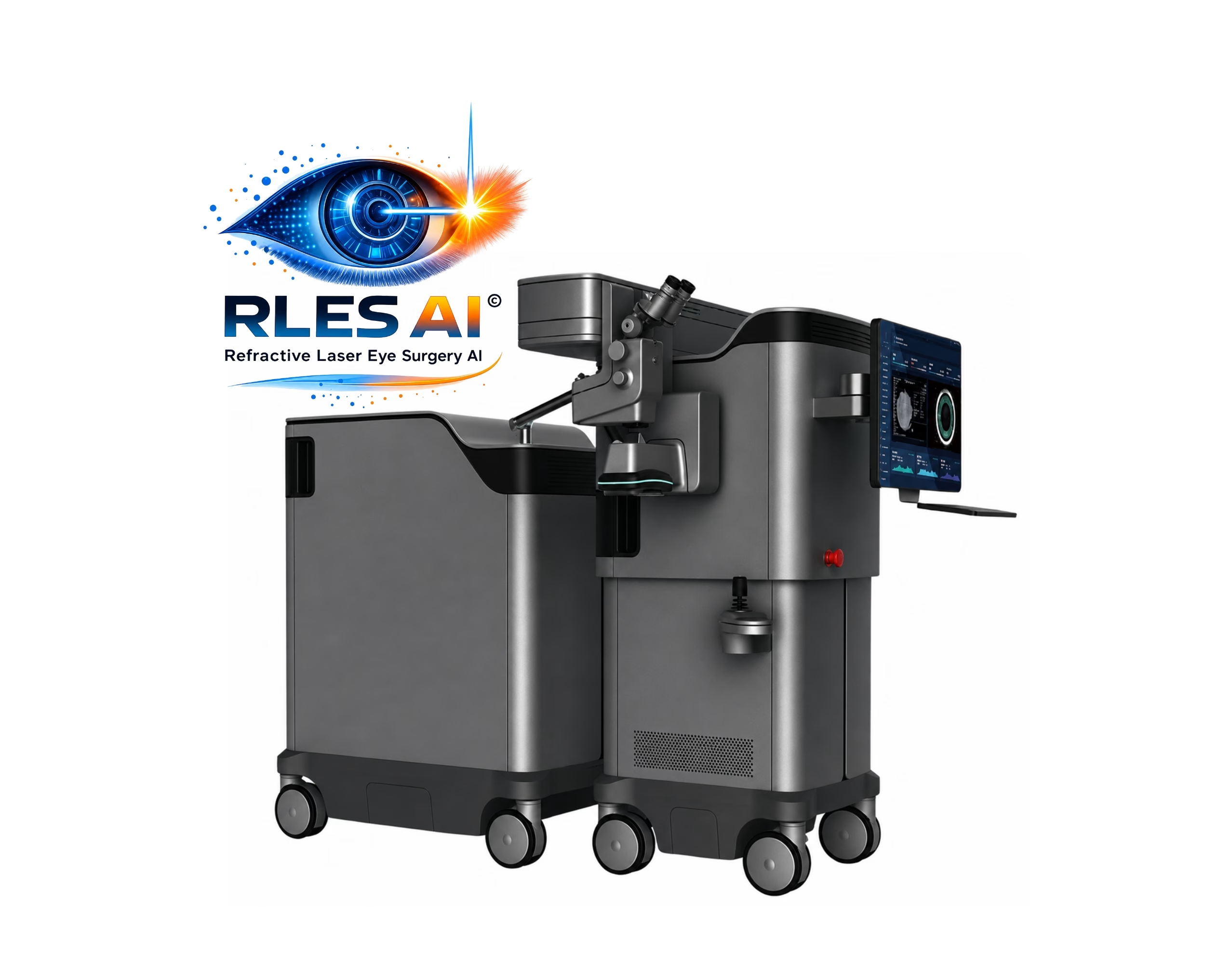
At Smart Laser Eye Centers, the RLES AI ® AI-assisted online robotic (1200 Hz) refractive excimer laser — brought to Türkiye at the beginning of 2026 by MCD Teknoloji, a company specialising in excimer laser technologies — is used successfully by our eye surgeons.

The robotic excimer laser, equipped with innovative technologies, is accompanied by the “Online (Live Surgery) Laser Operating Platform” developed by MCD Teknoloji engineers: together with its online remote-control systems and software, it was the first platform in the world to let eye surgeons receive training in laser eye treatments.

This excimer laser with robotic technology, which can be managed remotely through artificial-intelligence applications, makes it possible to plan laser eye surgery individually for each patient thanks to RLES AI ® , the artificial-intelligence application developed for the first time in the world by MCD Teknoloji.
“EYE TRACKER” and Close-Range Laser Delivery

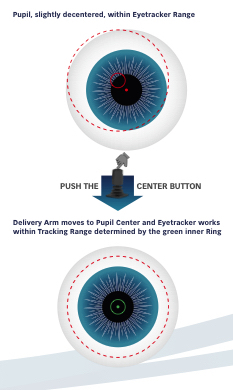
The 1200 Hz excimer laser developed with new technologies uses active “EYE TRACKER” technology successfully on the excimer laser platform. One of the most important factors affecting the success of laser eye surgery is the patient moving the eye during the laser pulse and the laser stopping as a result.

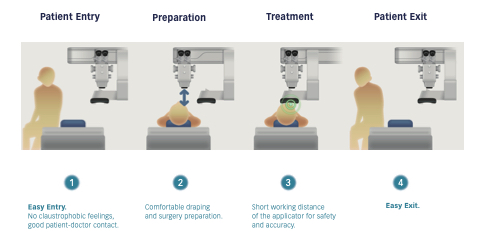
With active eye-tracking technology the laser can be delivered from the closest distance to the eye at a 90-degree perpendicular angle (7–8 cm). While the laser beams are applied to the most sensitive areas of the eye, the robotic system engages even if the eye moves (within limits) and locks onto the patient’s eye, so that the pulses are delivered to the intended coordinates of the eye.

Lazer Göz uygulama tekniği, Eye tracker, göz takip sistemi, Excelsius Excimer Laser

RLES AI ® Artificial Intelligence Technology in Refractive Laser Eye Surgery

Written and edited by the Smart Laser Eye Center Editorial Staff · Medically reviewed by Dr. Alim Huseynov, MD · Last updated: 11 September 2026

AI-assisted surgical planning

In laser eye surgery the result is determined not only by the device used, but by the plan given to that device. Planning requires a large number of values to be assessed together: corneal thickness, keratometry values, topography and tomography indices, the optical zone, the amount of tissue to be treated and the tissue that must remain in the cornea after surgery. At our centre this assessment is carried out together with RLES AI, the clinical decision-support software developed for refractive surgery planning. The software compares the measured values with published safety thresholds and with the device manufacturer’s nomogram; it shows where the limits are exceeded and which parameter needs to be changed.

What is examined

  • PTA (Percent Tissue Altered) — the proportion of tissue affected in total
  • RSB (residual stromal bed) and RCT (residual corneal thickness) — procedure-specific lower limits
  • Postoperative keratometry — the range within which the cornea can maintain its optical function
  • Ectasia risk indices — topography and tomography findings assessed together
  • Device nomogram — the manufacturer’s own tables for the microkeratome or femtosecond laser in use

The decision belongs to the surgeon

The output of the software is a recommendation and a checklist; it does not make a diagnosis and it does not decide on surgery. Which method is applied is decided by the surgeon, who evaluates all the findings together with the patient’s clinical condition. If the measurements do not support a method, this is stated openly and the alternatives are discussed.

“Plume Removal Ability”

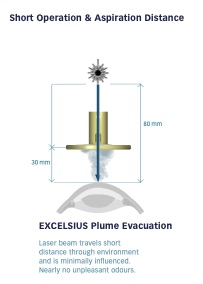
During laser surgery, corneal tissue vaporises as the laser beams are applied to the cornea. The plume created by the vaporised tissue absorbs the laser beams and can prevent the intended result from being achieved. For this reason the plume that forms during surgery is drawn away by an aspirator so that it does not cross the path of the laser beams.

In standard excimer laser systems the beams are delivered from about 20 cm and the plume is aspirated from a distance of roughly 10–15 cm. Because the plume travels some 15 cm before it is removed, it meets the laser beam on the way and absorbs part of the energy that should reach the eye, which can keep the surgeon from obtaining the intended result.

To remove this problem, this excimer laser can bring plume aspiration to within 1 cm of the eye, eliminating the risk that tissue plume from a pulse delivered at 7–8 cm crosses the beam path. This helps the operating surgeon obtain the intended correction.

Lazer Göz uygulama tekniği, Excelsius Excimer Laser

Online Remote Control and Robotic Surgery System

Because the excimer laser is controlled by an online remote-control system, more than one eye surgeon and laser engineer can connect to the laser eye surgery online, take part in the operation and contribute to its success.

In this way the preoperative calibration and settings of the excimer laser can be carried out or monitored remotely and online by our experienced engineers when needed. All technical parameters are approved and recorded before surgery.

The online control system also records the preoperative settings and calibrations — and indeed the whole course of the operation — which supports carrying out the procedure on a zero-error principle.

Lazer Göz uygulama tekniği, Excelsius Excimer Laser

It is a 5th-generation excimer laser managed with artificial intelligence and equipped with an online robotic system. With a single touch, and without the surgeon needing to intervene or adjust by hand, the robotic control system engages, brings the laser towards the patient’s eye, locks onto it and allows the procedure to be performed at the correct position.

Lazer Göz uygulama tekniği

Dynamic Matrix Algorithm

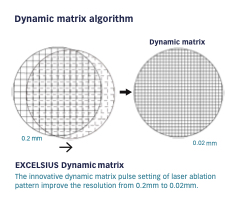
One of the most important features of the 5th-generation excimer laser is the dynamic matrix algorithm. In general, excimer lasers divide the eye into spot areas of about 0.5 mm² for each pulse and can deliver the laser with a maximum area precision of 0.2 mm². In short, standard excimer lasers divide the visual area of the eye into roughly 200 equal cells for laser application.

Thanks to the “Dynamic Matrix Algorithm” technology, the 5th-generation excimer laser makes the application area of the laser beams on the eye ten times finer, dividing it into 2000 equal areas — that is, spot areas of 0.02 mm².

The dynamic matrix algorithm reduces the ablation resolution from 0.5 mm² to 0.02 mm², divides the application area into 2000 equal parts and works together with the “topo-guided” system (corneal map) to support the intended correction on the cornea.

To picture it more easily, think of the difference between the first 1080p HD LED televisions and the latest 10K HD LED televisions; the same comparison applies to the sharpness of the ablation.

Lazer Göz uygulama tekniği

Optimized Flying Spot Technique

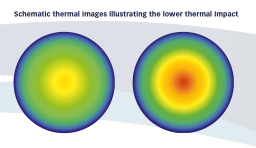
With standard excimer lasers, one of the complications eye surgeons are most cautious about during transepithelial PRK — the advanced version of PRK, also known as No-Touch — is “haze”, the corneal oedema caused by heat. Haze is generally described to the patient as hazy or blurred vision. In this method the cornea is exposed to more heat than usual because of the laser beams, so the surgeon applies a number of medications and procedures during surgery to prevent haze; these procedures, however, do not remove the risk of haze completely. If an excimer laser without technology to limit haze is used, hazy vision may still occur after surgery. Depending on your preoperative visual acuity, the ablation depth required by your refractive error and the residual stroma, haze may cause corneal clouding after surgery.

How long does haze take to resolve?

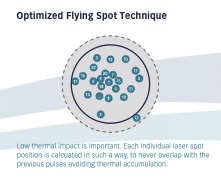
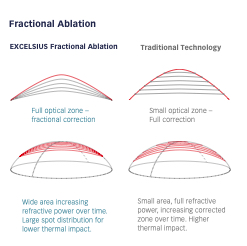
Because the clouding is due to oedema of the cornea, hazy or blurred vision may disappear over the medium term, within six months to a year. It is a complication that causes considerable difficulty for the patient, and some patients may need additional surgical treatment. To avoid this, the “Optimized Flying Spot Technique” was developed for the first time on this new-generation excimer laser, specifically for transepithelial PRK (No-Touch) surgery. With this technique, consecutive laser pulses are calculated so that they never fall on top of or next to the preceding pulses, which counteracts the thermal heating they would otherwise cause on the cornea. In this way the risk of haze — corneal oedema — in transepithelial PRK (No-Touch) surgery is minimised.

Fractional Ablation Technology

This is a wide-angle laser delivery technology developed to minimise the formation of haze, that is corneal oedema, in transepithelial PRK (No-Touch) surgery. Working together with the “Optimized Flying Spot Technique”, it counteracts high thermal heating in the same areas of the cornea from end to end while the laser beams are applied to the visual area of the eye. As a result it minimises the risk of blurred vision caused by haze.

Lazer Göz uygulama tekniği

Videos about the excimer laser technologies used at our eye centres

Frequently asked questions

Does the software decide on the surgery?

No. The software compares the measured values with safety thresholds; the decision is made by the surgeon, who evaluates all the findings.

Which values are examined during planning?

Corneal thickness, keratometry, topography and tomography indices, PTA, the residual stromal bed and the residual corneal thickness, together with the device nomogram.

What happens if my measurements are not suitable?

This is stated openly; alternatives such as surface ablation or an intraocular lens, or the option of not operating, are considered.

The physician who reviewed this page

Alim Huseynov, MD — Ophthalmologist — refractive laser surgery, cornea and oculoplastic surgery, Smart Laser Eye Center. Physician page

This page is general information only and is not a diagnosis or a treatment recommendation; suitability is determined by an eye examination.